
About this book
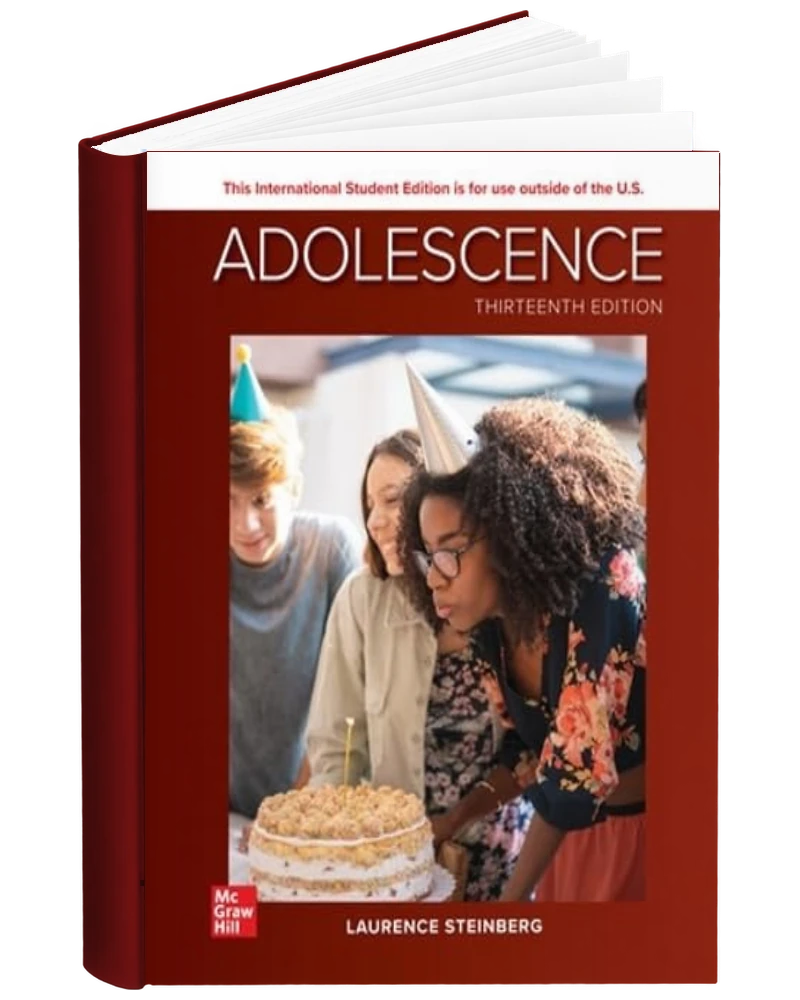
ISE Adolescence 13th Edition PDF by Laurence Steinberg is offered here as a PDF eBook. The thirteenth edition examines adolescence through biological, cognitive, emotional and social development while placing young people within family, peer, school, cultural and community contexts. It covers puberty and brain development, changes in thinking, identity, autonomy, intimacy, sexuality, achievement, risk behavior, mental health and the transition toward adulthood. Research findings are used to explain both typical developmental patterns and the wide variation among adolescents across environments and cultures. The text is especially useful for psychology, education and youth-services students who need to understand adolescence as a distinct developmental period shaped by both individual maturation and social context.
Designed for students of developmental psychology, education, and youth-related fields, this edition provides a structured resource for understanding how developmental changes interact with adolescents’ social environments.
This listing is for the 13th edition of ISE Adolescence. Check the title, edition, authors/editors, and other product information before ordering if you need the book for a particular course, syllabus, examination, or professional reference.
Transitions, Contexts, and Psychosocial Development
Steinberg’s Adolescence organizes the subject around fundamental developmental transitions, the settings in which adolescents live, and major psychosocial questions. Biological, cognitive, and social changes establish the foundation for chapters on families, peer groups, schools, work, leisure, and media. The text then considers identity, autonomy, intimacy, sexuality, achievement, and psychosocial problems. This structure places an adolescent’s development within several interacting contexts rather than presenting maturation as a single isolated process. The thirteenth edition connects scholarship with everyday experiences and considers variation across social, economic, and cultural backgrounds, supporting an informed account of both shared developmental patterns and individual differences.
Adolescent Changes and Social Settings
The 13th edition covers the following areas:
- Biological transitions: Physical changes associated with adolescence.
- Cognitive and social transitions: Changes in thinking and social position.
- Families and peers: Relationships and groups shaping adolescent experience.
- Schools, work, leisure, and media: Everyday settings and activities.
- Identity and autonomy: Development of a sense of self and independence.
- Intimacy, sexuality, and achievement: Important areas of psychosocial development.
- Psychosocial problems: Difficulties considered within adolescent development.
Understanding Adolescents in Context
This book is useful for readers who need to connect an adolescent’s behavior with developmental changes and surrounding relationships. A question about independence, for example, can involve cognitive development, family expectations, peers, and social roles at the same time. Steinberg’s three-part organization provides a way to examine those connections. Students can compare developmental transitions with the influence of schools, media, and work, then consider how identity or achievement develops within those settings. Readers preparing for education or youth-related work can use the text to build a research-informed perspective on adolescence that recognizes differences in social and cultural experience as well as common developmental themes.
Who uses this book
- Developmental Psychology Students
- Adolescent Development Students
- Education Students
- School Counseling Students
- Students Preparing for Youth Services Careers
- Social Work and Human Services Students
- Students Studying Identity, Peers and Family Relationships
- Adolescent Development Instructors
- Professionals Reviewing Research on Youth Development
Also suitable for other social- and behavioral-science learners who need a research-based account of adolescent development across biological, cognitive and social contexts.
Key Topics Covered
- Adolescent biological transitions
- Cognitive development
- Social transitions
- Family relationships
- Adolescent peer groups
- School contexts
- Work and leisure
- Media and adolescence
- Identity development
- Autonomy
- Intimacy
- Adolescent sexuality
- Achievement
- Psychosocial problems
PDF Edition Features
- Searchable reading: Quickly locate names, concepts, conditions, terminology, and other material with a compatible PDF reader.
- Highlighting and notes: Use annotation, bookmarking, and highlighting features supported by your chosen PDF application.
- Flexible access: Read the eBook on compatible computers, tablets, and mobile devices.
- Edition identification: Check the edition and product information before ordering to ensure it matches your requirements.
- Instant access: After successful payment, the download link is available through your order and sent to the email address used at checkout.



Reviews
There are no reviews yet.