
About this book
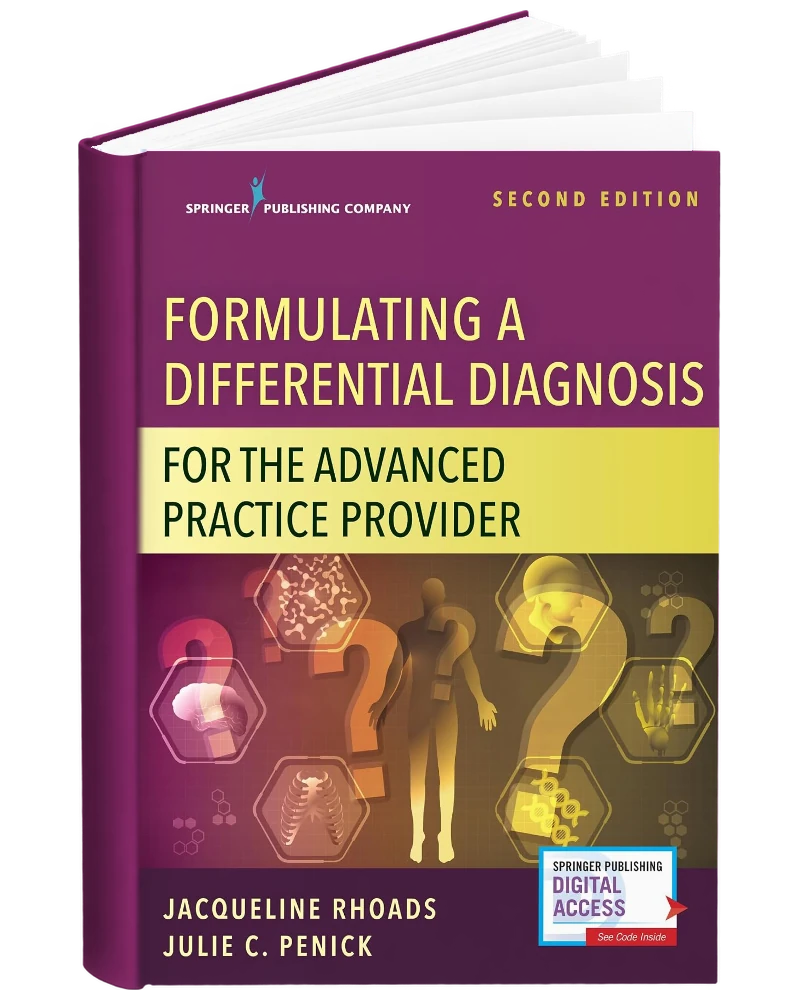
Formulating a Differential Diagnosis for the Advanced Practice Provider 2nd Edition PDF edited by Jacqueline Rhoads and Julie C. Penick is offered here as a PDF eBook. The second edition is a symptom-based diagnostic reasoning guide designed for advanced practice provider students and new clinicians. It presents more than 70 common complaints in an unfolding case-study format and walks readers through focused history taking, physical examination, differential diagnosis and selection of appropriate diagnostic studies. Differential tables help compare competing diagnoses, while case summaries make the critical-thinking process visible. The edition adds 22 symptoms and updates the approach to diagnostic evaluation, helping learners practice how information from the history and examination changes the probability of different conditions. It is especially useful for nurse practitioner and physician assistant training during the transition from data collection to independent clinical reasoning.
Designed for advanced practice providers and graduate clinical students, this edition provides a structured resource for understanding how findings from a patient presentation shape a differential diagnosis.
This listing is for the 2nd edition of Formulating a Differential Diagnosis for the Advanced Practice Provider. Check the title, edition, authors/editors, and other product information before ordering if you need the book for a particular course, syllabus, examination, or professional reference.
A Symptom-Based Approach to Differential Diagnosis
This second edition organizes diagnostic reasoning around presenting symptoms rather than starting with a known disease. More than seventy complaints provide entry points for working through possible explanations. Unfolding cases connect the chief complaint with current and past history, focused questions, examination findings, and diagnostic investigations. Differential tables and diagnostic-exam tables help readers compare possibilities as additional information becomes available. The range includes abdominal symptoms, chest pain, cough, fatigue, dizziness, mood changes, and problems involving vision or swallowing. With twenty-two additional symptoms in this edition, the book offers a broader collection of clinical presentations for advanced practice education and diagnostic discussion.
Presentations and Diagnostic Tools
The 2nd edition covers the following areas:
- Abdominal pain and swelling: Symptom-centered consideration of abdominal complaints.
- Chest pain and cough: History and findings relevant to cardiopulmonary presentations.
- Dizziness and fainting: Comparison of possible causes as case information unfolds.
- Fatigue and fever: Evaluation of commonly encountered systemic complaints.
- Vision, speech, and swallowing changes: Focused presentations that require careful clarification.
- Mood and confusion: Cases involving anxious mood, depressed mood, and altered thinking.
- Differential and investigation tables: Side-by-side support for comparing diagnoses and diagnostic examinations.
Using Unfolding Cases to Strengthen Diagnostic Reasoning
The book’s value lies in making the process of differential diagnosis visible. Students can examine how a focused question changes the significance of a symptom, then compare their reasoning with the accompanying tables and case summary. That format is helpful in advanced assessment courses, where recognizing a complaint is only the starting point: the task is to decide which additional findings discriminate among plausible causes. Its symptom-based organization also supports discussion of patients whose diagnoses are still uncertain. Faculty can use a single presentation to explore history taking, examination, and investigation together. The emphasis is on building a defensible diagnostic approach from the information available.
Who uses this book
- Nurse Practitioner (NP) Students
- Family Nurse Practitioner (FNP) Students
- Practicing Nurse Practitioners
- Physician Assistant (PA) Students
- New Advanced Practice Providers
- Students Learning Differential Diagnosis
- Learners Preparing for Advanced Health Assessment
- Advanced Practice Faculty and Clinical Preceptors
- Clinicians Strengthening Symptom-Based Diagnostic Reasoning
Also suitable for other advanced clinical trainees who need a step-by-step framework for moving from a presenting complaint to focused history, examination, testing and differential diagnosis.
Key Topics Covered
- Abdominal pain
- Abdominal swelling
- Chest pain
- Cough
- Hemoptysis
- Dizziness
- Syncope
- Fatigue
- Fever
- Dysphagia
- Diplopia
- Confusion
- Anxious mood
- Diagnostic investigations
PDF Edition Features
- Searchable reading: Quickly locate names, concepts, conditions, terminology, and other material with a compatible PDF reader.
- Highlighting and notes: Use annotation, bookmarking, and highlighting features supported by your chosen PDF application.
- Flexible access: Read the eBook on compatible computers, tablets, and mobile devices.
- Edition identification: Check the edition and product information before ordering to ensure it matches your requirements.
- Instant access: After successful payment, the download link is available through your order and sent to the email address used at checkout.




Reviews
There are no reviews yet.