

About this book
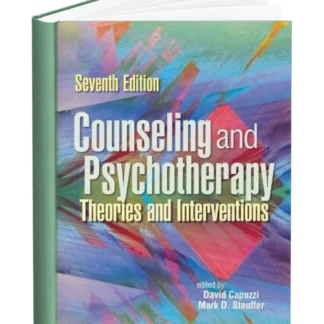
Counseling and Psychotherapy: Theories and Interventions 7th Edition PDF edited by David Capuzzi and Mark D. Stauffer is offered here as a PDF eBook. The seventh edition is a foundational counseling-theory text that compares major psychotherapeutic models and shows how each framework shapes case conceptualization, therapeutic goals and intervention choices. It covers psychodynamic, Jungian, Adlerian, existential, person-centered, Gestalt, cognitive-behavioral, third-wave cognitive-behavioral, rational-emotive, reality/choice, family, feminist, constructivist, emotion-focused, relational-cultural and creative approaches. Written by specialists in each model, the chapters help readers identify assumptions about change, the therapist-client relationship and the techniques associated with different orientations. The comparative structure is especially useful for graduate counseling students developing an integrated professional identity and learning to explain why a particular intervention follows from a particular theory.
Designed for counseling students, psychotherapy trainees, counselor educators, and helping professionals, this edition provides a structured resource for understanding how theoretical frameworks guide the understanding of a client and the selection of interventions.
This listing is for the 7th edition of Counseling and Psychotherapy: Theories and Interventions. Check the title, edition, authors/editors, and other product information before ordering if you need the book for a particular course, syllabus, examination, or professional reference.
Comparing Counseling Theories in the Seventh Edition
This edited textbook presents a range of theoretical approaches used to understand clients and guide therapeutic work. A recurring case study gives readers a shared point of comparison across approaches. The value of that design is that the client remains recognizable while the theoretical interpretation changes. Students can therefore examine what a model draws attention to, what it regards as a goal, and how it understands change. The seventh edition provides a setting for comparing frameworks before pursuing a particular approach in greater depth, supporting informed discussion of theory rather than treating models as interchangeable sets of techniques.
Theoretical Approaches Represented
The 7th edition covers the following areas:
- Psychodynamic, Jungian, and Adlerian approaches: Distinct frameworks for understanding psychological experience.
- Existential and person-centered theories: Perspectives centered on meaning and the individual’s experience.
- Gestalt therapy: A separate approach within the range of models discussed.
- Cognitive and behavioral approaches: Cognitive behavioral, third-wave, and rational emotive theories.
- Reality therapy and family approaches: Additional models for conceptualizing therapeutic work.
- Relational-cultural and feminist perspectives: Frameworks that bring relationships and social context into discussion.
- Constructivist and emotion-focused approaches: Further perspectives alongside creative counseling applications.
Understanding What Changes When the Theory Changes
This textbook is useful when a student needs to explain why two therapists might interpret the same client differently. The repeated case makes the comparison concrete: a reader can hold the presenting situation in view while considering the assumptions of each model. That supports classroom discussion of what counts as a therapeutic goal and what kind of intervention follows from it. For trainees developing a professional orientation, comparison can help identify questions to pursue through further study and supervision. Educators can use the same structure to ask for a reasoned theoretical account, rather than a list of techniques detached from the framework that gives them purpose.
Who uses this book
- Graduate Counseling Students
- Clinical Mental Health Counseling Students
- School Counseling Students
- Marriage and Family Therapy Students
- Psychotherapy Trainees
- Social Work Students Studying Counseling Theories
- Counselors Reviewing Multiple Therapeutic Models
- Counselor Educators and Clinical Supervisors
- Students Developing Case Conceptualization Skills
Also suitable for other helping-profession learners who need to compare major counseling theories and understand how theoretical orientation guides case formulation and intervention.
Key Topics Covered
- Relational-cultural theory
- Psychodynamic therapy
- Jungian theory
- Adlerian counseling
- Existential therapy
- Person-centered counseling
- Gestalt therapy
- Cognitive behavioral theories
- Third-wave cognitive behavioral approaches
- Rational emotive therapy
- Reality therapy
- Family theories
- Feminist theory
- Constructivist approaches
- Emotion-focused therapy
PDF Edition Features
- Searchable reading: Quickly locate names, concepts, conditions, terminology, and other material with a compatible PDF reader.
- Highlighting and notes: Use annotation, bookmarking, and highlighting features supported by your chosen PDF application.
- Flexible access: Read the eBook on compatible computers, tablets, and mobile devices.
- Edition identification: Check the edition and product information before ordering to ensure it matches your requirements.
- Instant access: After successful payment, the download link is available through your order and sent to the email address used at checkout.


Reviews
There are no reviews yet.