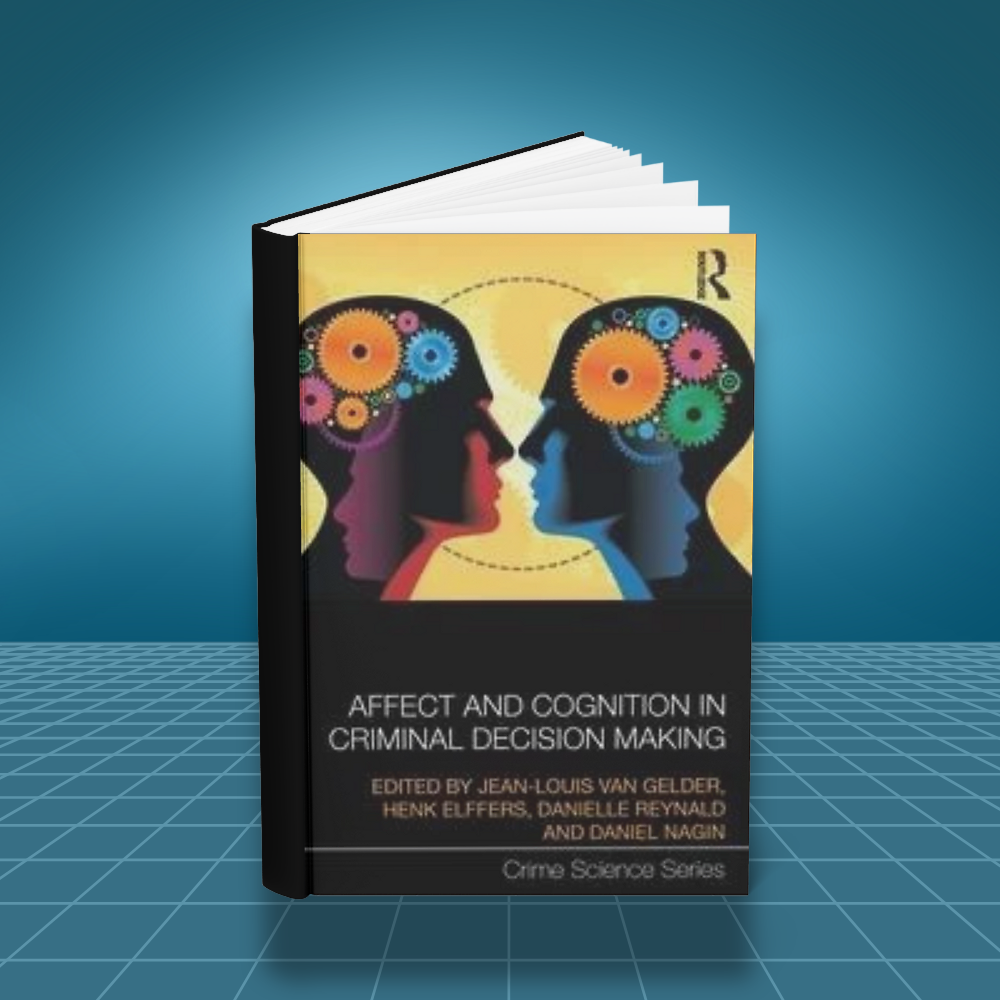
Affect and Cognition in Criminal Decision Making 1st edition
What You'll Receive?
Complete 1st edition
Instant access after purchase
Fully searchable PDF for quick navigation between chapters
Before you buy
This is an eBook/PDF product only. No physical book will be shipped.
Please confirm the book title and edition before completing your purchase.
Your PDF download link will be sent to the email address used at checkout, immediately.
About this book
Affect and Cognition in Criminal Decision Making 1st Edition PDF is a detailed digital study and reference resource for readers working with criminal decision-making, affect, cognition, rational-choice models, behavioral economics, psychology, and neuroscience. Written or edited by Jean-Louis van Gelder, Henk Elffers, Danielle Reynald, and Daniel Nagin and published by Routledge, this edition is useful for structured coursework, exam preparation, teaching, research-oriented review, and professional learning.
The book is especially valuable because it connects foundational ideas with applied interpretation. Readers can use the chapters to build vocabulary, understand major frameworks, compare competing concepts, and revisit important details when preparing for assignments, examinations, supervised training, or professional development. In searchable PDF format, the title also works well as a reference when a specific term, concept, method, or section needs to be found quickly.
Affect and Cognition in Criminal Decision Making 1st Edition PDF overview
The Affect and Cognition in Criminal Decision Making 1st Edition PDF is designed for criminology students, psychology students, researchers, educators, and readers studying behavioral decision-making. A useful way to approach the text is to begin with the core principles, then move into applied examples and specialized topics. This supports both first-time learning and later revision. Readers can also combine the text with lecture notes, current guidelines, case discussions, practice questions, or research literature depending on the subject.
- The role of emotion in criminal decisions: The edition develops this area in a way that supports structured study, applied reasoning, and topic review.
- Cognitive and rational-choice perspectives: The edition develops this area in a way that supports structured study, applied reasoning, and topic review.
- Visceral factors and decision processes: The edition develops this area in a way that supports structured study, applied reasoning, and topic review.
- Behavioral-economics approaches to offending: The edition develops this area in a way that supports structured study, applied reasoning, and topic review.
- Psychological and neuroscientific perspectives: The edition develops this area in a way that supports structured study, applied reasoning, and topic review.
- Conceptual and empirical research on criminal choice: The edition develops this area in a way that supports structured study, applied reasoning, and topic review.
Key learning value of Affect and Cognition in Criminal Decision Making 1st Edition PDF
The Affect and Cognition in Criminal Decision Making 1st Edition PDF can be used to create a more active study process. Rather than reading large sections without a plan, identify a specific learning goal first, locate the relevant chapter or section, summarize the main points, and then test your understanding by applying the material to a question, case, example, image, procedure, or concept comparison. This approach can improve retention and make revision more efficient.
Because this edition covers criminal decision-making, affect, cognition, rational-choice models, behavioral economics, psychology, and neuroscience, it is suitable for both broad review and targeted lookup. Students can work through the material in sequence during a course, while educators and professionals can use the searchable format to return directly to a topic. The ability to search, highlight, annotate, and bookmark in a compatible PDF reader makes it easier to build a personal reference system around the sections most relevant to your goals.
Who can use Affect and Cognition in Criminal Decision Making 1st Edition PDF?
Affect and Cognition in Criminal Decision Making 1st Edition PDF can support criminology students, psychology students, researchers, educators, and readers studying behavioral decision-making. Students may use it before lectures, after class, during assignment preparation, or for exam revision. Educators can use it to identify core concepts and reading topics. Trainees and professionals can return to the text when refreshing knowledge, preparing for supervised work, comparing methods, or revisiting important terminology and frameworks.
When the subject involves clinical, technical, or professional decisions, the textbook should be used alongside current institutional guidance, instructor direction, applicable standards, and up-to-date professional sources. Textbooks are excellent for foundational learning, but rapidly changing areas may require consultation of current guidelines and recent evidence.
Verified authors and edition information
Bibliographic and publisher information identifies Affect and Cognition in Criminal Decision Making 1st edition with Jean-Louis van Gelder, Henk Elffers, Danielle Reynald, and Daniel Nagin and Routledge. You can review the edition or publisher information before purchase. KINDLEIT recommends confirming the title and edition against your syllabus, course requirements, reading list, certification plan, or preferred professional reference.
For related titles, browse the KINDLEIT medical ebook shop and use the KINDLEIT FAQs for ordering, access, and file-support information.
How to study with Affect and Cognition in Criminal Decision Making 1st Edition PDF
Use the Affect and Cognition in Criminal Decision Making 1st Edition PDF with a repeatable workflow. Start by writing down what you need to learn. Search the book for the relevant chapter or term, read the surrounding explanation, and record a concise summary. Then connect the material with an example or application. If the chapter contains several related ideas, build a comparison table or short outline. If it contains procedures, methods, or image-based material, review the sequence and the reasoning behind each step instead of memorizing isolated facts.
During revision, return to bookmarked sections and search for high-yield terms rather than rereading the entire book. Highlight only the points that directly support your objectives. This creates a leaner study record and makes later review more efficient.
Criminology students, psychology students, researchers, educators, and readers studying behavioral decision-making can use this edition to strengthen subject knowledge, support coursework or professional education, and keep a convenient searchable reference available for continued learning. The complete edition is provided as a searchable PDF. Order confirmation is sent immediately after checkout, and ebook access is provided by email.