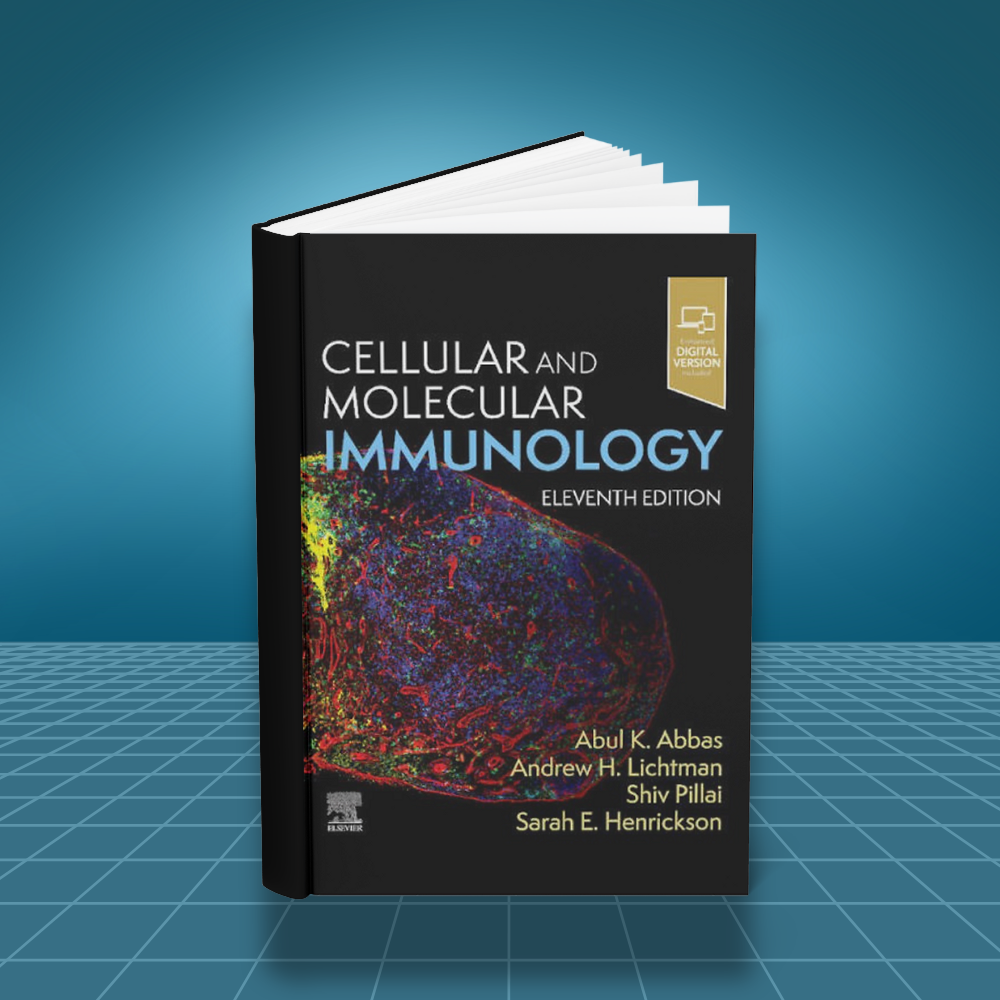
Cellular and Molecular Immunology 11th edition
What You'll Receive?
Complete 11th edition
Instant access after purchase
Fully searchable PDF for quick navigation between chapters
Before you buy
This is an eBook/PDF product only. No physical book will be shipped.
Please confirm the book title and edition before completing your purchase.
Your PDF download link will be sent to the email address used at checkout, immediately.
About this book
Cellular and Molecular Immunology 11th Edition PDF is an original, study-focused product description for Cellular and Molecular Immunology 11th edition by Abul K. Abbas, Andrew H. Lichtman, Shiv Pillai, and Sarah Henrickson. Published by Elsevier, this edition offers structured coverage of cellular and molecular immunology, innate immunity, adaptive immunity, lymphocyte activation, antibodies, immune regulation, hypersensitivity, immunodeficiency, and immune-mediated disease. It can support formal coursework, examination preparation, clinical or professional education, teaching, and targeted reference when readers need to revisit a specific concept efficiently.
The text is most useful when it is treated as an active learning resource rather than simply read from beginning to end. Readers can identify a learning objective, locate the relevant section, build a concise summary, and then connect the material with a patient scenario, problem, technique, research question, or real-world example. The searchable PDF format makes it easier to locate terminology, chapters, and key phrases and to build a personalized set of bookmarks, highlights, and notes.
Cellular and Molecular Immunology 11th Edition PDF overview
The Cellular and Molecular Immunology 11th Edition PDF is designed for medical students, graduate students, biomedical scientists, physicians, educators, and immunology researchers. It helps readers move from foundational knowledge toward practical interpretation and application. Students can use the book to prepare before class and consolidate material afterward, while clinicians and other professionals can return to focused sections to refresh knowledge before a case, procedure, discussion, or continuing-education activity.
- Innate immunity and early host defense: Organized coverage helps readers connect core concepts with study, clinical reasoning, or professional application.
- Antigen recognition and lymphocyte activation: Organized coverage helps readers connect core concepts with study, clinical reasoning, or professional application.
- T-cell and B-cell immune responses: Organized coverage helps readers connect core concepts with study, clinical reasoning, or professional application.
- Antibody structure and effector mechanisms: Organized coverage helps readers connect core concepts with study, clinical reasoning, or professional application.
- Immune tolerance and regulation: Organized coverage helps readers connect core concepts with study, clinical reasoning, or professional application.
- Hypersensitivity, immunodeficiency, transplantation, and tumor immunity: Organized coverage helps readers connect core concepts with study, clinical reasoning, or professional application.
What readers can learn from Cellular and Molecular Immunology 11th Edition PDF
Coverage of cellular and molecular immunology, innate immunity, adaptive immunity, lymphocyte activation, antibodies, immune regulation, hypersensitivity, immunodeficiency, and immune-mediated disease makes this edition suitable for both broad review and topic-specific study. During a course, readers can work through chapters in sequence and relate each chapter to lectures, objectives, or practical sessions. During revision, they can search directly for weaker topics and use the surrounding explanation to rebuild understanding instead of memorizing isolated facts.
A useful study routine is to begin each session with one question. After reading the relevant material, write a short answer without looking at the book. Then reopen the text, identify what was missed, and add only the information needed to correct the gap. When the material describes multiple conditions, theories, methods, or procedures, a comparison table can be especially effective. When a sequence is important, convert it into a checklist and explain the purpose of each step.
Who can use Cellular and Molecular Immunology 11th Edition PDF?
Cellular and Molecular Immunology 11th Edition PDF can support medical students, graduate students, biomedical scientists, physicians, educators, and immunology researchers. Students may use the edition for pre-reading, lecture review, assignments, skills preparation, and exams. Educators can use it to identify central concepts and structure reading. Practitioners can use relevant chapters as a refresher and as a starting point for deeper review of a topic.
Where content affects patient care or other professional decisions, use the textbook together with current guidelines, institutional policies, specialty recommendations, and recent peer-reviewed evidence. That combination preserves the value of a strong textbook foundation while accounting for changes in standards and practice.
Verified author and edition information
Publisher and bibliographic information identify Cellular and Molecular Immunology 11th edition with Abul K. Abbas, Andrew H. Lichtman, Shiv Pillai, and Sarah Henrickson and Elsevier. Review the publisher or bibliographic information before ordering. KINDLEIT recommends confirming the exact title and edition against your syllabus, reading list, certification requirements, or preferred professional reference.
For more titles, browse the KINDLEIT medical ebook shop. For ordering, ebook access, replacement, and file-support information, see the KINDLEIT FAQs.
How to study with Cellular and Molecular Immunology 11th Edition PDF
Use the searchable PDF to make review more efficient. Search for high-yield terminology, bookmark the chapters you use frequently, highlight selectively, and keep notes short enough that they remain useful during later revision. If a chapter includes tables, figures, algorithms, or structured frameworks, review how each component relates to the surrounding explanation rather than studying the visual in isolation.
During exam preparation, use retrieval practice: try to explain a topic from memory first, then use the book to check accuracy and fill gaps. During professional education, search the relevant topic and read enough context to understand limitations and assumptions. Revisit current authoritative guidance for information that is time-sensitive.
Medical students, graduate students, biomedical scientists, physicians, educators, and immunology researchers can use this edition to strengthen subject knowledge, support coursework or professional education, and maintain a convenient searchable reference for continued learning. The complete edition is provided as a searchable PDF. Order confirmation is sent immediately after checkout, and ebook access is provided by email.