
About this book
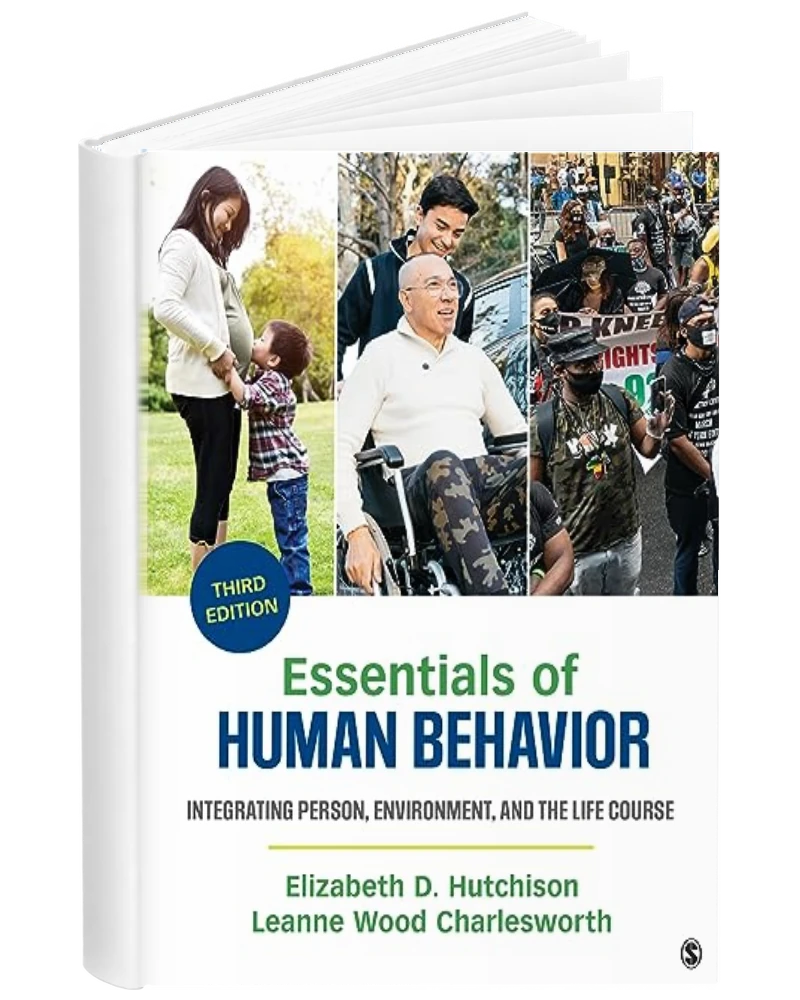
Essentials of Human Behavior: Integrating Person, Environment, and the Life Course 3rd Edition PDF by Elizabeth D. Hutchison and Leanne Wood Charlesworth is offered here as a PDF eBook. The third edition combines person, environment and time into one integrated social-work framework for understanding human behavior. It reviews biological and psychological influences, culture, identity, families, groups, organizations, communities, physical environments and developmental transitions across the life course. Updated content addresses equity and inclusion, trauma and resilience, environmental justice, gender identity and expression, helping readers connect theory with contemporary social-work concerns. The text is especially useful in Human Behavior in the Social Environment (HBSE) courses because it encourages students to analyze client situations multidimensionally rather than explain behavior through a single theory or individual factor.
Designed for social work students, human services learners, and instructors teaching human behavior in the social environment, this edition provides a structured resource for understanding how personal experience, social context, and historical time shape human behavior.
This listing is for the 3rd edition of Essentials of Human Behavior: Integrating Person, Environment, and the Life Course. Check the title, edition, authors/editors, and other product information before ordering if you need the book for a particular course, syllabus, examination, or professional reference.
An Integrated Person–Environment Perspective
Essentials of Human Behavior combines the person, environment, and time dimensions in one volume for human behavior coursework. The third edition relates biological and psychological processes to culture, families, groups, organizations, communities, and wider social institutions. Its life course framework considers transitions, trajectories, turning points, and the links between individual lives and historical circumstances. The edition also examines equity, inclusion, trauma, resilience, and environmental justice. Rather than treating a person’s circumstances as a single isolated cause, the book provides multiple perspectives for considering their interactions. This integrated scope supports social work courses connecting theory and research with understanding people in context.
Human Behavior Across Interacting Dimensions
The 3rd edition covers the following areas:
- Biology and environment: Relationships between bodily systems, health, and external circumstances.
- Cognition and emotion: Theories of thinking, emotion, relationships, stress, and coping.
- Culture and physical settings: Cultural meanings, power, natural surroundings, and the built environment.
- Family life: Family theories, diversity, relationship changes, and sources of stress or resilience.
- Groups and organizations: Small group processes, formal organizations, and social service settings.
- Communities and institutions: Community perspectives, social inequality, institutions, and social movements.
- Life course concepts: Cohorts, trajectories, transitions, life events, and turning points.
- Developmental contexts: Conception and infancy, adolescent development, and contextual risk and protection.
Considering More Than One Dimension of a Case
Social work case analysis requires attention to a person’s experience and to the conditions surrounding that experience. This book is useful for bringing those perspectives into the same discussion. A family difficulty, for example, can be examined through relationships and coping while also considering cultural expectations, organizations, and access to community resources. The life course perspective adds questions about timing, earlier transitions, and linked lives. Students can therefore compare explanations instead of relying on one theory for every situation. The volume’s integrated approach is particularly relevant to coursework asking learners to explain how human behavior knowledge informs engagement, assessment, intervention, and evaluation.
Who uses this book
- Bachelor of Social Work (BSW) Students
- Master of Social Work (MSW) Students
- Human Behavior in the Social Environment (HBSE) Students
- Human Services Students
- Social Work Practicum Students
- Students Studying Person-in-Environment Perspectives
- Students Examining Trauma, Resilience and Social Context
- Social Work Educators
- Practitioners Reviewing Human Behavior Theory
Also suitable for other human-services learners who need to connect individual development with families, communities, culture, physical environments and the life course.
Key Topics Covered
- Person-in-environment perspective
- Biological systems and social context
- Cognition and emotion
- Stress and coping
- Attachment and relational theories
- Culture and power
- Natural and built environments
- Family diversity and resilience
- Small group processes
- Formal organizations
- Community theories
- Social institutions and inequality
- Social movements
- Life course transitions and trajectories
- Developmental risk and protection
PDF Edition Features
- Searchable reading: Quickly locate names, concepts, conditions, terminology, and other material with a compatible PDF reader.
- Highlighting and notes: Use annotation, bookmarking, and highlighting features supported by your chosen PDF application.
- Flexible access: Read the eBook on compatible computers, tablets, and mobile devices.
- Edition identification: Check the edition and product information before ordering to ensure it matches your requirements.
- Instant access: After successful payment, the download link is available through your order and sent to the email address used at checkout.



Reviews
There are no reviews yet.