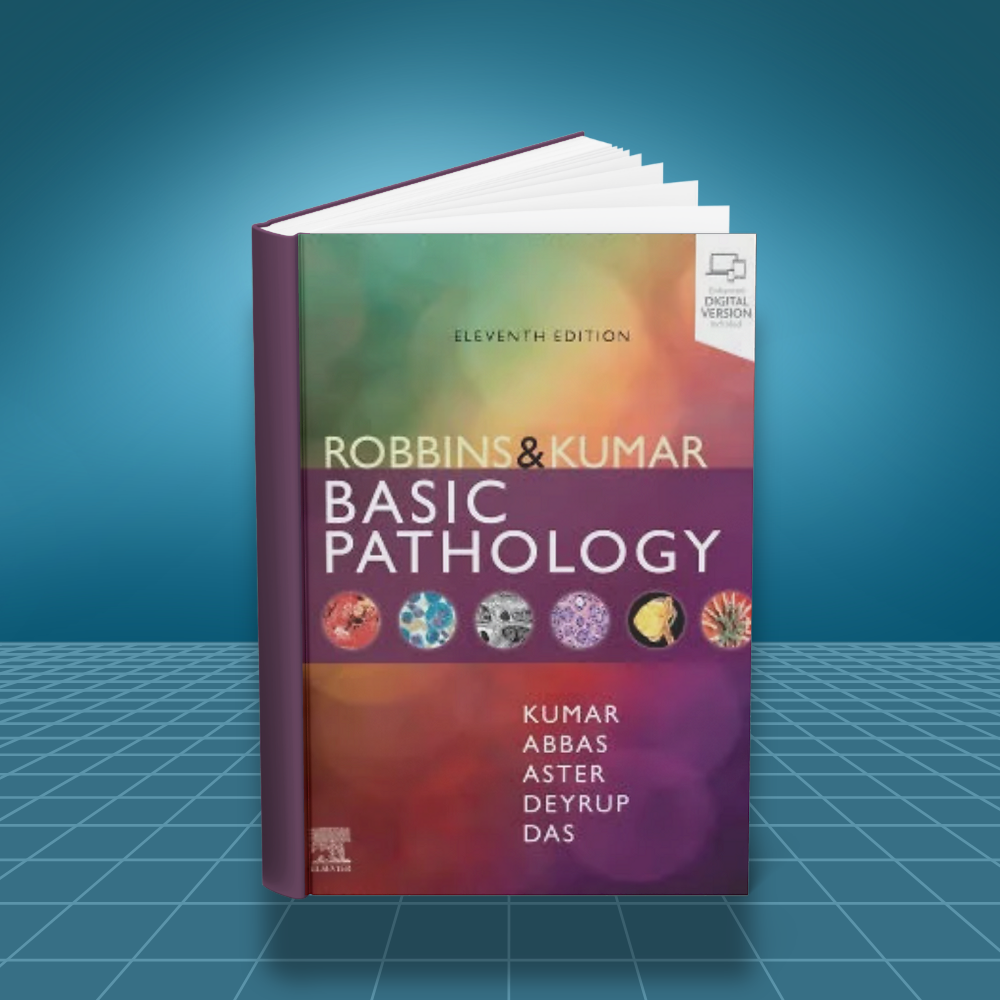
If you are choosing between Robbins Basic Pathology, 10th Edition and Robbins & Kumar Basic Pathology, 11th Edition, the decision is mostly about how current you need the material to be and whether your course references a specific edition.
Our recommendation
For a new pathology course in 2026, choose the 11th Edition. It is the current edition, adds updated clinical material, more schematic teaching tools, a new Rapid Review section, chapter-level laboratory-test tables, and stronger emphasis on molecular pathology.
Choose the 10th Edition only if your syllabus specifically assigns it, your lecturer uses its chapter/page numbering, or you already own it and do not need the newer teaching features.
Robbins Basic Pathology 10th vs 11th Edition at a glance
| Feature | 10th Edition | 11th Edition |
|---|---|---|
| Publication era | 2017 | 2022/2023 |
| Best for | Courses still assigned to the 10th; solid foundational pathology | Students starting now who want the current Basic Pathology edition |
| Core emphasis | Pathogenesis, morphology and clinical features of disease | Same core framework with updated clinical and molecular pathology |
| Review support | Strong illustrations and schematic diagrams | Adds a dedicated Rapid Review section and 150+ new schematic diagrams |
| Diagnostics | Core clinicopathologic correlation | Adds laboratory-test tables that connect disease mechanisms with diagnostic testing |
| Our pick | Good if specifically required | Best overall choice for a new purchase |
Best overall: Robbins & Kumar Basic Pathology 11th Edition
Our recommendation: if you are buying a pathology textbook now and your course does not mandate the 10th Edition, buy the 11th.
Elsevier describes Robbins & Kumar Basic Pathology, 11th Edition as a concise, highly illustrated introduction to the essential mechanisms and manifestations of disease. It retains the classic Robbins emphasis on pathogenesis, morphology and clinicopathologic correlation while updating the material for contemporary medical education.
Why we prefer the 11th Edition
- It is the current Basic Pathology edition. That matters most when your course expects newer terminology, disease mechanisms and diagnostic context.
- The Rapid Review section is genuinely useful. Bulleted take-home summaries make the book easier to revisit before exams.
- There are more than 150 new schematic diagrams. Pathology is easier to retain when mechanisms are shown visually instead of buried in paragraphs.
- Laboratory-test tables improve clinical correlation. They connect pathophysiology with the tests used to evaluate disease.
- Molecular pathology receives stronger emphasis. That better reflects the way modern disease mechanisms and diagnostics are taught.
- Clinical material is updated throughout. This is the biggest reason to prefer the newer edition when starting from scratch.
Who should buy the 11th Edition?
Medical students beginning pathology, allied-health students in formal pathology courses, learners preparing for integrated systems blocks, and anyone buying one Basic Pathology edition for long-term study.
Who may not need to upgrade?
If your lecturer explicitly assigns the 10th Edition and tests from its page numbers, images or chapter references, changing editions can create unnecessary friction. The 10th remains a strong foundational pathology text.
Access Robbins & Kumar Basic Pathology 11th Edition →
When Robbins Basic Pathology 10th Edition still makes sense
Our recommendation: keep or choose the 10th if the course is built around that edition. Do not upgrade just because a newer number exists if your instructor is assigning exact 10th-edition chapters and figures.
The 10th Edition already established the format that makes Robbins Basic Pathology useful: readable explanations, strong emphasis on pathogenesis and clinical features, extensive photomicrographs and gross pathology images, and schematic diagrams that summarize disease mechanisms.
Why the 10th Edition is still useful
- The core pathology principles have not become obsolete. Cell injury, inflammation, neoplasia, immune disease, hemodynamic disorders and organ-system pathology remain the foundation of the course.
- It is still clinically oriented. The text consistently connects disease mechanisms with manifestations.
- The visual program is strong. Microscopic images, gross specimens, radiologic images and conceptual drawings remain valuable for learning morphology.
- It may match older course materials better. Lecture slides, reading assignments and question banks sometimes cite the 10th Edition directly.
Who should choose the 10th Edition?
Students whose syllabus names the 10th Edition, learners using a course built around its chapter sequence, or readers who already own it and only need the foundational content.
Who should skip the 10th?
If you are purchasing your first pathology text today and no course requirement ties you to the older edition, the 11th is the better long-term choice.
Access Robbins Basic Pathology 10th Edition →
Is the 11th Edition different enough to justify upgrading?
For a first-time buyer: yes. The newer edition is not simply a cover change. The updated clinical material, new Rapid Review section, additional schematic diagrams, diagnostic laboratory tables and stronger molecular-pathology emphasis make it easier to study and more current.
For someone who already owns the 10th: it depends. If the 10th is working for your course and your exam is based on your lecturer’s materials, you do not automatically need to replace it. Upgrade when your course expects the newer edition or when you specifically want the newer review and diagnostic features.
Which Robbins book is best for medical students?
For most preclinical medical students who want a concise core pathology textbook, Robbins & Kumar Basic Pathology 11th Edition is the better starting point. It is designed to cover the essential mechanisms of disease without the depth and volume of the larger comprehensive Robbins pathology reference.
If you are in a pathology-heavy program, doing deeper specialty study, or want a reference beyond a standard medical-school course, a more comprehensive pathology text may eventually make sense. But for a typical undergraduate medical pathology course, Basic Pathology is usually the more manageable first choice.
How to study Robbins efficiently
- Start with the mechanism. Before memorizing morphology, make sure you understand why the disease process occurs.
- Use the diagrams actively. Reproduce important pathways from memory instead of only looking at them.
- Connect morphology to consequences. Ask how the microscopic or gross change produces the clinical presentation.
- Use Rapid Review after the chapter, not before it. In the 11th Edition, the summary works best as consolidation rather than a replacement for understanding.
- Pair reading with questions. Pathology becomes easier to retain when disease mechanisms are repeatedly retrieved in a clinical context.
Final recommendation
Buy Robbins & Kumar Basic Pathology 11th Edition if you are starting now. It is the more current, better-supported edition and the new review and diagnostic features improve its usefulness for both learning and exam revision.
Use Robbins Basic Pathology 10th Edition if your course explicitly requires it or you already own it. Its core pathology teaching remains strong, so an upgrade is not mandatory for every student.
For more pathology resources, read the KINDLEIT Pathology & Immunology guide or browse the Pathology & Immunology collection.
Editorial method: recommendations are based on the intended audience, edition changes, teaching features and publisher information. Edition details were checked against Elsevier’s official pages for Robbins Basic Pathology 10th Edition and Robbins & Kumar Basic Pathology 11th Edition.