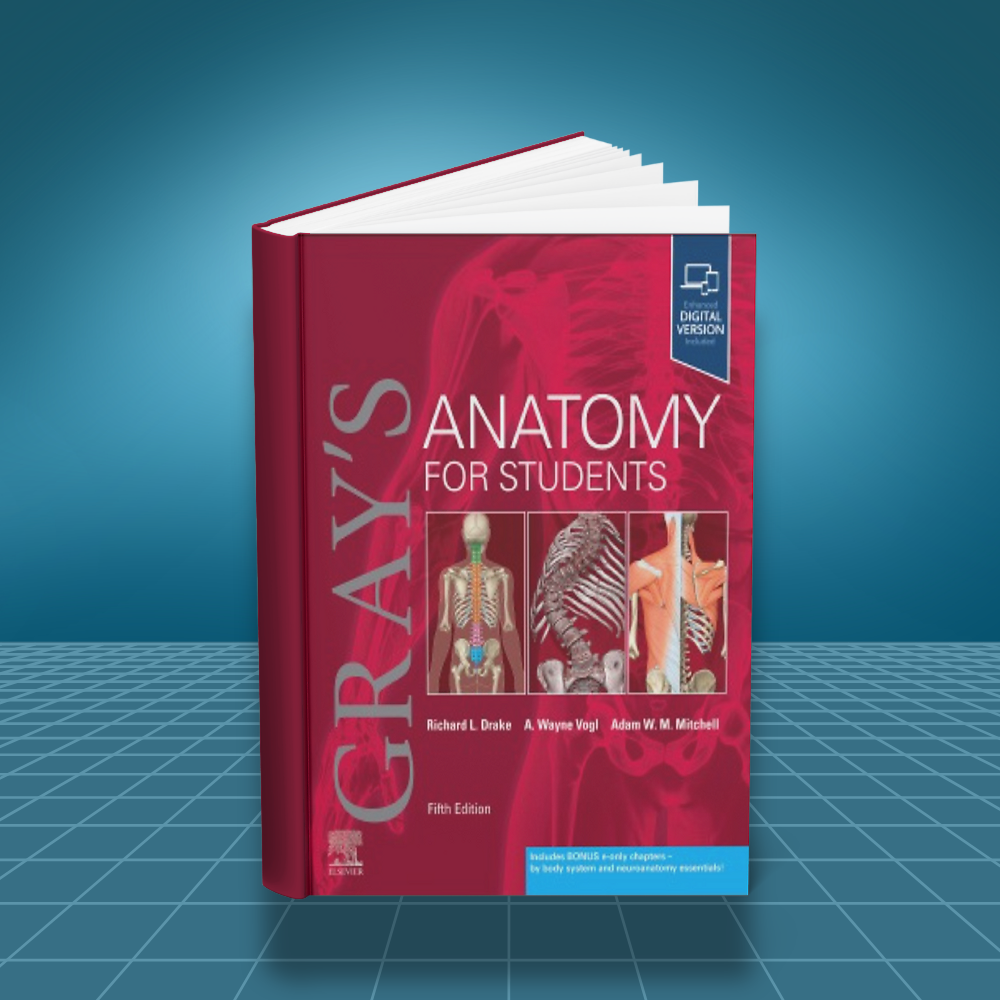
If you are choosing between the major Gray’s Anatomy study books, the most important question is not which title is “best” in general. It is what job you need the book to do: teach anatomy from the ground up, test you before an exam, give you a faster high-yield overview, or act as a visual atlas.
Our Gray’s Anatomy recommendations
- Best overall primary anatomy textbook: Gray’s Anatomy for Students, 5th Edition
- Best for exam practice and active recall: Gray’s Anatomy Review, 3rd Edition
- Best compact option: Gray’s Basic Anatomy, 3rd Edition
- Best for visual identification and dissection-lab study: Gray’s Atlas of Anatomy, 3rd Edition
If you can buy only one: choose Gray’s Anatomy for Students if you are taking a full medical or health-science anatomy course. It is the most complete teaching resource of the four.
Gray’s Anatomy books compared at a glance
| Book | Best for | Main strength | Main limitation |
|---|---|---|---|
| Gray’s Anatomy for Students 5th Ed. | Primary course study | Full explanations + strong illustrations | More time-consuming than a review book |
| Gray’s Anatomy Review 3rd Ed. | Exam preparation | 1,400+ questions with rationales | Not a substitute for learning anatomy from scratch |
| Gray’s Basic Anatomy 3rd Ed. | Efficient core review | Concise and clinically focused | Less depth than the full student text |
| Gray’s Atlas of Anatomy 3rd Ed. | Visual learning and lab work | Large, clinically focused illustrations | Not designed to replace explanatory textbook reading |
1. Best overall: Gray’s Anatomy for Students 5th Edition
Our recommendation: this is the strongest first choice for most medical students and other learners who need a complete anatomy textbook rather than a revision aid.
Elsevier describes Gray’s Anatomy for Students, 5th Edition as a concise, readable anatomy text focused on the core information medical students need. The edition is edited by Richard L. Drake, A. Wayne Vogl and Adam W. M. Mitchell and contains more than 1,000 original illustrations, conceptual overviews and simplified schematic drawings designed to make complex anatomy easier to understand.
Why we recommend it
- It teaches rather than just tests. You get enough explanation to understand relationships between structures, not merely memorize labels.
- The visual program is a major strength. Anatomy is spatial, so high-quality illustrations matter.
- It works well as the “main book.” You can use a review book or atlas alongside it instead of trying to force one resource to do everything.
- It covers the major regions you expect in a medical anatomy course: back, thorax, abdomen, pelvis and perineum, limbs, head and neck, and neuroanatomy.
Who should buy it?
Choose this if you are beginning a serious anatomy course, want one main reference for the semester, or need explanations that connect structures with clinical context.
Who might skip it?
If you already know the material and your only goal is rapid exam drilling, this may be more book than you need. In that case, Gray’s Anatomy Review is more efficient.
Access Gray’s Anatomy for Students 5th Edition →
2. Best for exams: Gray’s Anatomy Review 3rd Edition
Our recommendation: choose this when your foundation is already in place and you need to convert knowledge into exam performance.
Elsevier positions Gray’s Anatomy Review, 3rd Edition as a question-based review resource for in-course examinations and USMLE-style preparation. It contains more than 1,400 high-yield questions with answers and rationales, including a neuroanatomy chapter with roughly 100 additional questions.
Why we recommend it
- Active recall is built into the format. You are forced to retrieve the answer rather than simply reread a paragraph.
- Rationales make mistakes useful. A missed question tells you exactly what needs another pass.
- It pairs naturally with the main student text. Study a body region, then test yourself on that same region.
- It is more efficient near exams. Question practice often gives clearer feedback than passive rereading.
Who should buy it?
Medical students preparing for anatomy exams, learners using question-based study, and anyone who already owns a primary anatomy textbook.
Who should not use it as their only book?
Beginners who still need detailed explanations. A question bank can expose a knowledge gap, but it cannot always teach the underlying anatomy as clearly as a full text.
Access Gray’s Anatomy Review 3rd Edition →
3. Best compact option: Gray’s Basic Anatomy 3rd Edition
Our recommendation: this is the most sensible Gray’s title for learners who want a shorter, more efficient anatomy text without moving all the way down to a pure review book.
Elsevier describes Gray’s Basic Anatomy, 3rd Edition as a concise, easy-to-read anatomy text with strong clinical focus, full-color illustrations and integration with imaging and surface anatomy. Its intended readership includes medical students, physician-assistant students and allied-health learners.
Why we recommend it
- Less intimidating than a full-length anatomy text.
- Good for health-science programs that do not require maximum depth.
- Clinical examples help keep the anatomy relevant.
- Useful when time is limited. You can cover the core concepts without spending as long on every region.
Who should buy it?
Allied-health students, PA students, nursing or rehabilitation learners who need anatomy depth beyond a basic A&P book, and medical students who prefer a more concise secondary text.
Who might prefer the full Students edition?
If anatomy is a major foundational course in your program and you want more explanation and depth, Gray’s Anatomy for Students is still the stronger primary investment.
Access Gray’s Basic Anatomy 3rd Edition →
4. Best visual atlas: Gray’s Atlas of Anatomy 3rd Edition
Our recommendation: choose the Atlas if your biggest difficulty is identifying structures visually, understanding spatial relationships, or preparing for dissection and practical exams.
Elsevier describes Gray’s Atlas of Anatomy, 3rd Edition as the companion resource to Gray’s Anatomy for Students, with clinically focused illustrations that show anatomical structures alongside clinical images and surface anatomy.
Why we recommend it
- Strong for visual learners.
- Useful in dissection and practical-exam preparation.
- Pairs well with explanatory reading. Read the concept in the textbook, then use the atlas to reinforce the visual relationships.
- Clinical-image correlation helps bridge textbook anatomy and real imaging.
Who should buy it?
Students preparing for anatomy lab practicals, learners who struggle with spatial relationships, and anyone who wants a dedicated visual companion.
Who should not rely on it alone?
An atlas shows anatomy exceptionally well, but it is not the strongest stand-alone resource for explaining every concept in depth. Pair it with a teaching text.
Access Gray’s Atlas of Anatomy 3rd Edition →
Best Gray’s Anatomy combination for different students
Medical student taking anatomy for the first time
Recommended combination: Gray’s Anatomy for Students + Gray’s Anatomy Review.
Use the main text to learn each region, then use Review to test it. This gives you both understanding and retrieval practice.
Student preparing for a practical anatomy exam
Recommended combination: Gray’s Anatomy for Students + Gray’s Atlas of Anatomy.
The textbook gives the explanation; the atlas reinforces structure identification and spatial relationships.
Student with limited study time
Recommended combination: Gray’s Basic Anatomy + Gray’s Anatomy Review.
You get a more concise core text and a strong question-based review tool without committing to the full-length Students edition.
Allied-health learner
Recommended starting point: Gray’s Basic Anatomy.
It offers a clinically relevant foundation without assuming that every learner needs the same depth as a full medical anatomy curriculum.
What we would buy if choosing only one
For most medical students, our single-book recommendation is Gray’s Anatomy for Students, 5th Edition. It is the one title in this group that can most realistically serve as your main anatomy textbook.
If you already have another primary anatomy book and simply want to improve exam performance, buy Gray’s Anatomy Review, 3rd Edition instead.
If visual identification is your weakest area, add Gray’s Atlas of Anatomy. If the full student text feels too detailed for your program, choose Gray’s Basic Anatomy.
How to use these books efficiently
- Learn the region: read the relevant chapter in Students or Basic Anatomy.
- Draw or label structures from memory: do not keep the page open while recalling.
- Check the atlas: compare your mental map with a clear visual reference.
- Test yourself: work through Review questions for the same region.
- Return only to weak areas: avoid rereading chapters you already understand.
Final recommendation
The Gray’s titles are strongest when you choose by function rather than by name recognition:
- Need one main textbook? Gray’s Anatomy for Students.
- Need exam questions? Gray’s Anatomy Review.
- Need a shorter core text? Gray’s Basic Anatomy.
- Need visual identification? Gray’s Atlas of Anatomy.
For a wider comparison beyond the Gray’s series, read the KINDLEIT Anatomy & Physiology textbook guide or browse the Anatomy & Physiology collection.
Editorial method: recommendations are based on each title’s intended use, publisher-described features and the study task it is best suited to. Publisher information was checked against Elsevier’s official title pages.
Hi, this is a comment.
To get started with moderating, editing, and deleting comments, please visit the Comments screen in the dashboard.
Commenter avatars come from Gravatar.